
How AI in Retail Drives Growth, Efficiency, and Customer Experience
Discover how AI in Retail transforms the industry with key use cases, benefits, and implementation challenges. Learn how AI enhances customer experience, inventory management, and sales forecasting.
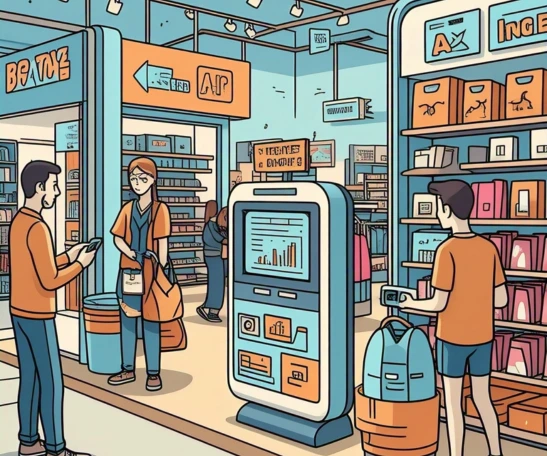
What is AI in Retail?
Artificial Intelligence (AI) is rapidly transforming the retail landscape. From enhancing the customer experience to optimizing inventory management, AI in retail is revolutionizing how businesses operate. This article explores the major use cases, benefits, and implementation challenges of artificial intelligence in the retail industry.
AI in retail refers to the application of technologies such as machine learning, computer vision, predictive analytics, and natural language processing (NLP) to automate processes, gain insights, and improve customer experience. Retailers use AI to offer smarter, faster, and more personalized shopping experiences both online and in-store.
Use Cases of AI in Retail
AI is being deployed across various segments of the retail industry. Some of the most impactful use cases include:
Personalized Shopping Experiences
- AI customer experience tools such as recommendation engines use predictive analytics to analyze shopper behavior and suggest products tailored to individual preferences.
- NLP-powered chatbots in retail guide customers in real time, enhancing engagement and reducing bounce rates.
Smart Inventory Management
AI helps in inventory optimization by predicting demand patterns using machine learning.
Demand forecasting minimizes overstock and stockouts, ensuring the right products are available at the right time.
In-Store Analytics
Computer vision and facial recognition technology allow retailers to monitor foot traffic and shopper behavior.
Insights gained help in optimizing store layout and product placement.
Retail Automation and Robotics
Robotics in retail handle tasks such as shelf scanning and restocking.
Automation enhances operational efficiency and reduces human error.
Dynamic Pricing and Visual Search
AI algorithms enable dynamic pricing by analyzing competitor data, customer demand, and buying trends.
Visual search tools allow customers to search for products using images instead of text.
Omnichannel Retail Strategy
AI ensures consistency across all customer touchpoints, including eCommerce, mobile apps, and physical stores.
Benefits of AI for Retail Businesses
| Benefit | Description |
|---|---|
| Improved Customer Satisfaction | Personalized recommendations and real-time support create a seamless shopping experience. |
| Reduced Operational Costs | Retail automation and predictive analytics cut down on labor and logistics expenses. |
| Boosted Sales | AI tools help increase conversion rates through tailored promotions and upselling. |
| Enhanced Decision-Making | Data-driven insights enable faster, more accurate business decisions. |
| Optimized Store Layout | In-store analytics help organize product displays for maximum impact. |
| Streamlined Checkout | AI systems can automate and accelerate checkout processes. |
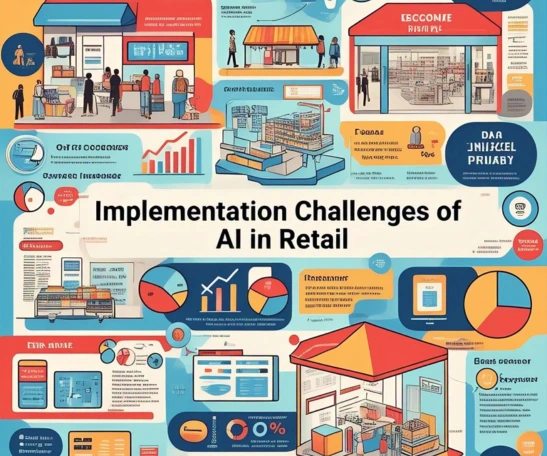
Implementation Challenges of AI in Retail
While the benefits are clear, implementing AI solutions in the retail sector is not without challenges:
1. High Implementation Cost
AI solutions often require significant upfront investment in software, hardware, and talent.
2. Data Privacy and Security
Handling sensitive customer data necessitates robust data security and compliance with privacy regulations like GDPR.
3. Integration with Legacy Systems
Many retailers struggle to integrate new AI tools with outdated infrastructure.
4. Scalability Issues
Scaling AI systems across multiple stores or regions can be complex and costly.
5. Staff Training and Change Management
Retail workforce automation may face resistance; effective training and communication are key to smooth adoption.
Future Trends: AI in Retail 2025 and Beyond
Looking ahead, AI trends in retail 2025 point toward deeper personalization, enhanced visual search, and the rise of hyper-automated stores. AI in eCommerce will become even more refined, and IoT in retail will further enhance connectivity across systems.
Retailers that invest in AI today will not only improve current operations but also future-proof their businesses for the digital era.
Conclusion
AI in the retail industry is no longer a futuristic concept—it is a present-day reality reshaping customer experiences and business strategies. From recommendation engines and dynamic pricing to robotics and visual search, artificial intelligence in retail is paving the way for smarter, more efficient operations.
By understanding the use cases, benefits, and implementation challenges, businesses can strategically adopt AI-powered retail solutions that boost growth and improve customer satisfaction.
FAQ
AI is used in retail for personalized shopping experiences, inventory optimization, in-store analytics, retail automation, dynamic pricing, and omnichannel strategies. Tools like recommendation engines, chatbots, and visual search enhance customer engagement and operational efficiency.
AI improves customer satisfaction by offering personalized recommendations, real-time support via chatbots, streamlined checkout processes, and tailored marketing. It enables a seamless and engaging shopping experience across both online and physical stores.
Major challenges include high implementation costs, data privacy concerns, integration with legacy systems, scalability issues, and the need for staff training and change management to adapt to new technologies.
AI uses predictive analytics and machine learning to forecast demand, optimize inventory levels, and streamline supply chain operations. This reduces stockouts, minimizes overstocking, and improves logistics efficiency.
While large enterprises often lead in AI adoption due to budget flexibility, small and mid-sized retailers can also benefit through affordable AI-powered SaaS tools, chatbots, and analytics platforms that improve efficiency and customer engagement without massive investment.
-
 Eliane Owner of Wize Consult
Next Debug did a Great work ! one of the best Company I have had the pleasure to work with ! highly recommended !!
Read more -
 Raymond Owner of Key Biz
Excellent service provider. I real pleasure to work with Next Debug.
Read more -
 Cresita Owner of Sky Web Design
Next Debug did a great job. I look forward to working again.
Read more
